
WJP In The News
Featured

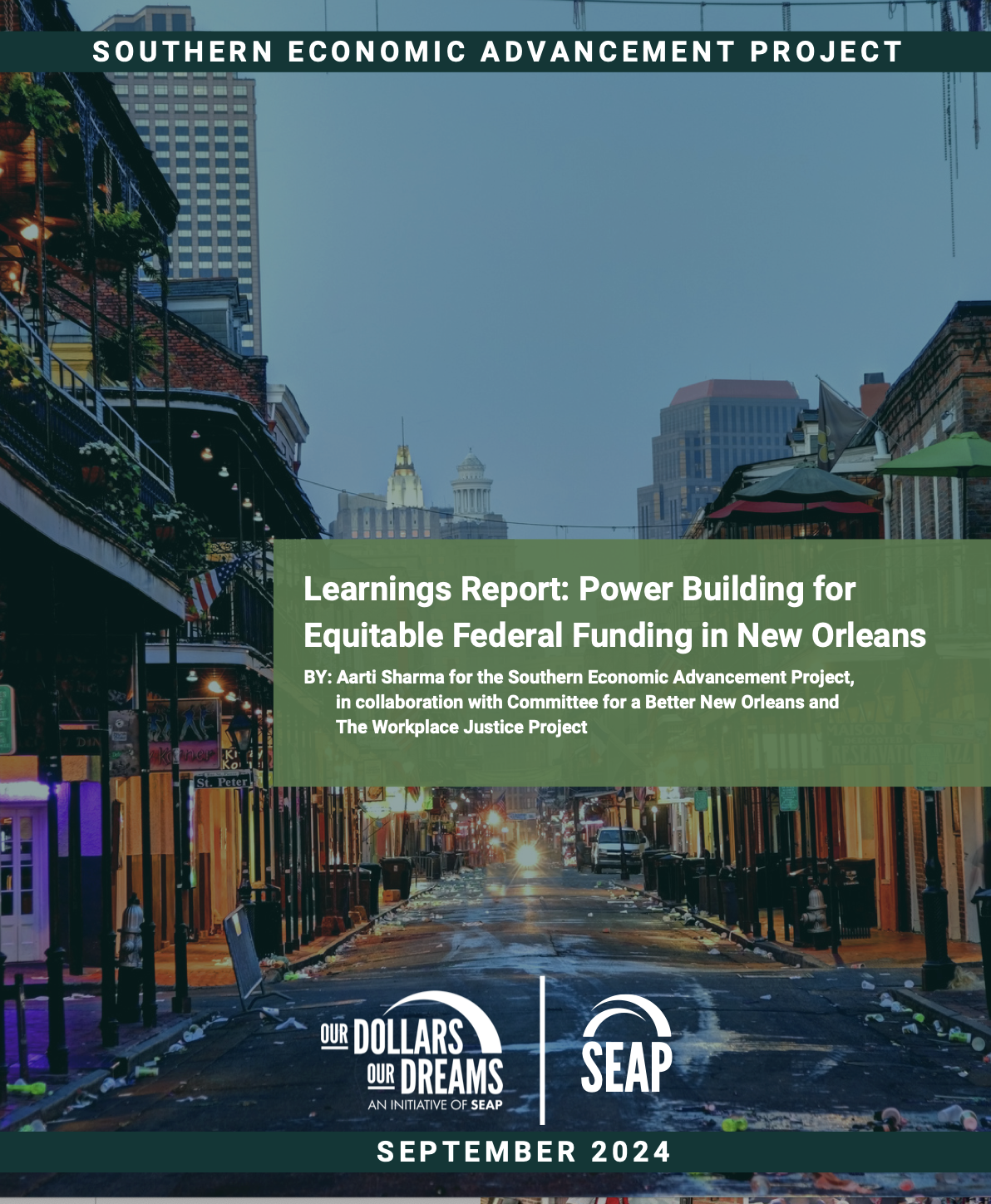






This learnings report chronicles and synthesizes the work of the Building Equity Collaborative in New Orleans, LA from 2022 through 2024. The report offers lessons learned and a roadmap for coalitions working to put equity front and center in funding discussions and decisions in their communities.
The Building Equity Collaborative is co-convened by the Workplace Justice Project (WJP) and the Committee for a Better New Orleans (CBNO.)
Erika Zucker, WJP’s Director of Policy & Advocacy spoke with the Valley Labor Report about work and worker organizing in the South.
The new federal law protecting pregnant workers, the Pregnant Workers Fairness Act, goes into effect on Tuesday, June 27, 2023. Learn about what the EEOC says you should know about the new law, via its online article, accessible here.
WJP Senior Staff Attorney, Andrea M. Agee, explains how to make a “demand” for your unpaid wages under Louisiana law. You can also check out our example of a demand letter for unpaid wages.
What is wrongful termination?
How do you know when termination is from a job is just bad for your bottom line or actually violates the law?
WJP Senior Staff Attorney, Andrea M. Agee, has this explainer. #KnowYourRights
WJP Clinic student William Ercole explains the basics to answer the question “are you an employee or an independent contractor?”
Unfortunately, Louisiana is not on this list. And, while city workers and those who work on city contracts will see a modest raise, most workers in New Orleans and other cities in our state will not see a wage increase. However, the continuing trend of higher minimum wages is something to celebrate.
Our friends at RIDE New Orleans released their annual State of Transit report in November. There’s some good news and some more work to be done.
Transportation equity will be a key component of the WJP’s Summit on Building a More Equitable New Orleans. Read more here.
Workers across the country and in a variety of industries are in the news for demanding respect and fair treatment for their labor. Thanks to labor reporter Josh Eidelson for compiling this list of actions that may seem novel, but are not, in fact new.
Coming on April 22, 2022
The WJP will host a day-long summit to create a practical vision for tackling economic inequity in Greater New Orleans. Please plan to join us.
Look for more information here and in your in-box in early 2022.
WJP and partners present a webinar on protecting the rights of pregnant workers in Louisiana.
Spearheaded by a coalition of building trades’ unions and the WJP, the New Orleans City Council adopted an ordinance that emphasizes accountability for all the rights of all workers on projects with city contracts.
Yesterday the New Orleans City Council approved a $15.00 per hour minimum wage for all city workers. Congratulations to NOCWOC, and to our partners at StepUp Louisiana, the City’s Firefighters, and all who worked so hard to make this happen. Thanks to the City Council for the unanimous approval to ensure that our City budget will provide livable wages for public sector workers.
If you lost work or were unable to get work as a result of Hurricane Ida, and live in a designated disaster area, you can now apply for Disaster Unemployment Assistance (DUA) through November 2, 2021.
“State Rep. Valarie Hodges has introduced a bill targeting immigrants that could make it more difficult for Louisianans to claim dependents on their annual tax returns, particularly those of lower-income with children studying abroad.”
“Drawing on 2014 U.S. Census data, a recent report from Loyola University’s Workplace Justice Project noted 34 percent of Orleans Parish’s primary jobs that paid less than $1,250 a month were in “accommodation and food services.”
“In New Orleans, protesters stormed down Carrollton Avenue at dawn and right into a McDonald’s restaurant as they continue to demand change when it comes to minimum wages in the city, state and nation.”
“Louisiana ranks 51st — dead last among all states and the District of Columbia — in an index of nine “social justice indicators” that measure poverty, racial disparity and immigrant exclusion, according to experts from the Jesuit Social Justice Research Institute at Loyola University New Orleans.”
“Shorting workers also contributes to the state’s budget crisis, Zucker said, by keeping various taxes out of the coffers. Louisiana faces a $70 million budget gap for the fiscal year that ends in June, and a $750 million gap next year. If companies were forced to pay their employees and to report it accurately, “We could fill a little bit of that hole,” she said.”
“Latino workers, some of whom are undocumented, went to New Orleans in the days and weeks following the disaster to help with reconstruction efforts and debris and mold removal.”
“We called him when we were done with the house, but he didn’t answer,” Alvarado said, adding that they later learned the contractor had left to Texas and had no intention of paying them. “He ended up owing us a total of $12,000 for the work that we did for about a month.”
“Erika Zucker, policy advocate with the Workplace Justice Project, said, “The Living Wage Ordinance is a good first step for the workers of New Orleans.”
“Estimates of the wages pilfered from construction workers after Hurricane Katrina run to the tens of millions of dollars.”
“Twenty-nine states and the District of Columbia have set their own minimum wages above the federal $7.25 minimum wage. Louisiana is one of five states that does not have its own minimum wage law.”